A Practical Guide to Planning factory-direct purchasing from China
Factory-direct purchasing can improve communication and price visibility, but the buyer takes on more coordination across specification, quality, payment, production, and freight. A direct relationship works best when the legal seller, actual factory, process capabilities, responsibilities, and escalation path are documented before the first order.
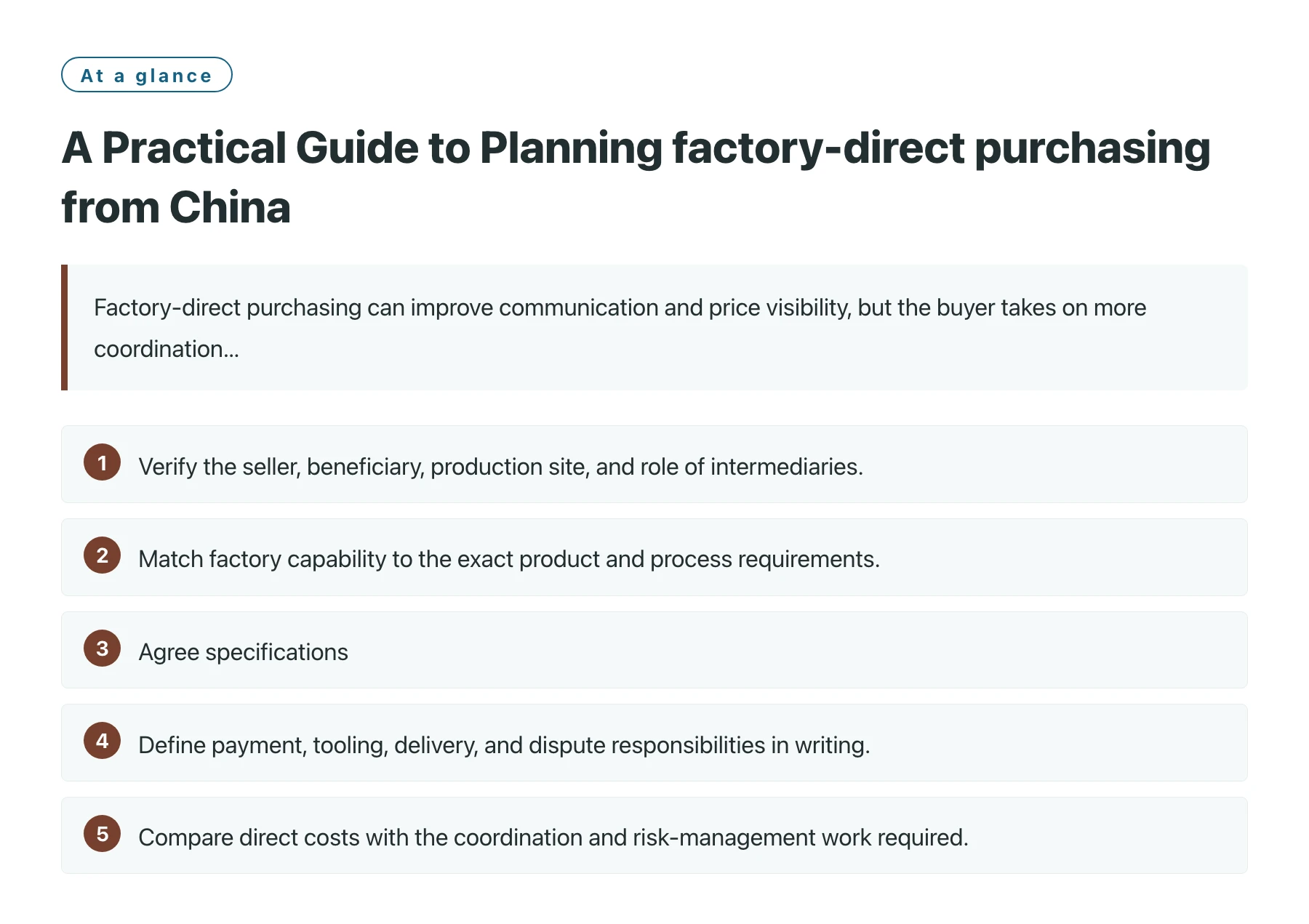
Key takeaways
- Verify the seller, beneficiary, production site, and role of intermediaries.
- Match factory capability to the exact product and process requirements.
- Agree specifications, approved samples, changes, and quality checkpoints.
- Define payment, tooling, delivery, and dispute responsibilities in writing.
- Compare direct costs with the coordination and risk-management work required.
Going direct is an operating model decision: compare the full responsibilities and controls, not only the quoted unit price.
1. Decide what “factory direct” means for this purchase
Clarify whether the buyer is contracting with the factory, a trading company, an export entity affiliated with the factory, or another intermediary. Ask who manufactures, who invoices, who receives payment, who controls production, and who is responsible for quality and delivery. Confirm that each role is disclosed in the quotation and agreement.
Direct purchasing does not eliminate intermediaries in logistics, testing, export services, or components. The goal is a transparent responsibility map, not a label. Decide which activities the buyer can manage internally and which need a qualified sourcing or inspection partner.
2. Verify legal identity and payment details
Collect the legal company name, address, registration identifiers, business contact, and contract entity. Independently confirm payment instructions through a known contact using a second channel, especially after any change to bank details. Ensure the beneficiary and invoicing arrangement match the contract or are explained and approved.
Ask who can sign the contract and authorize changes. Keep quotations, purchase orders, invoices, payment milestones, tooling agreements, and correspondence in one order file. For cross-border transactions, have appropriate legal and finance advisers review material terms, tax, and payment risks.
3. Confirm the actual production site and capability
Request the factory address, site contact, process map, equipment list relevant to the product, and the role of subcontractors. Ask which operations are done in-house and which are outsourced. Review examples of comparable production, capacity evidence, tooling control, and technical staff experience.
A company profile or virtual tour is not enough to establish product capability. Connect evidence to the exact model, material, tolerance, volume, and production process. If a site visit or independent audit is appropriate, agree scope, access, timing, and records to review in advance.
4. Define a specification the factory can quote consistently
Prepare drawings, bill of materials, material grades, dimensions, performance criteria, finish, packaging, labeling, inspection points, and revision level. Distinguish mandatory requirements from acceptable alternatives. Require the supplier to identify exceptions explicitly rather than assuming every line has been accepted.
Ask technical questions early and document assumptions. Have the factory confirm manufacturability, tolerance capability, tooling needs, minimum quantities, and long-lead materials. The buyer remains responsible for deciding whether a proposed deviation fits the product and market requirements.
5. Control samples, tooling, and changes
Define whether samples are prototypes, approval samples, or production-intent samples. Record materials, process, version, date, and acceptance status. Set out tooling ownership, storage, maintenance, access, amortization, and return or transfer terms in writing.
Use a controlled change request for material, component, site, process, packaging, label, or drawing changes. Require impact review, updated sample or evidence where needed, and buyer approval before implementation. A direct factory relationship can shorten communication, but informal messaging should not replace revision control.
6. Build quality checks and corrective action into the order
Agree incoming, in-process, final, packaging, and document checks based on product risk. Specify lot identity, sampling method, acceptance limits, report contents, inspection access, and shipment-release authority. Consider third-party inspection when independence or local presence is useful.
ISO 9001 provides requirements for a quality management system, but certification does not guarantee that a specific product or lot conforms. Verify certification scope and site, then review product-specific controls and evidence. For nonconformities, require containment, root cause, corrective action, owner, due date, and verification. [1]
7. Negotiate commercial terms beyond unit price
Compare minimum order, price breaks, quote validity, currency, deposit, balance timing, tooling, packaging, spare parts, warranty, cancellation, and remedies for defects or delay. Define the specification and delivery basis attached to the price. Model landed cost using the same assumptions across factories.
Clarify intellectual property, confidentiality, ownership of buyer-provided designs, permitted subcontracting, and restrictions on unauthorized production. Have counsel draft or review terms where the commercial exposure warrants it. Do not assume a supplier’s standard pro forma invoice covers every operational risk.
8. Plan production, communication, and shipment
Create a milestone schedule for sample approval, material readiness, production start, in-process checks, final inspection, packing, documents, and dispatch. Name one owner for each milestone and agree how delays are reported. Keep forecasts distinct from firm purchase orders and capacity commitments.
Set the delivery rule and named place, shipping documents, booking responsibilities, and handoff records. Incoterms® rules can clarify specified delivery tasks, costs, and risks when incorporated into the contract, but other terms and import responsibilities must also be addressed. Track actual delivery against the planned date.
9. Compare the direct model with alternatives
Calculate total cost after adding the buyer’s time, translation, supplier coordination, travel, inspection, compliance review, payment risk, freight, and issue resolution. Compare that with a sourcing partner or distributor whose fee may include services the buyer otherwise must staff. Use the same product, order, and delivery assumptions.
Factory-direct purchasing may suit repeat orders with stable specifications, capable internal procurement, clear communication, and accessible quality oversight. For new products, fragmented supply chains, tight deadlines, or limited local coverage, additional support may reduce workload or risk. Evaluate actual evidence and needs rather than assuming one model is always better.
10. Start with a controlled first order
Begin with a manageable order scope, confirm all critical documents and approved sample conditions, and set explicit inspection and release gates. Record baseline lead time, quality results, responsiveness, actual cost, and corrective-action performance. Review after receipt before scaling volume.
Buyers seeking sourcing manufacturers in China should define supplier verification, specification control, factory oversight, and shipment follow-up before placing a commitment. Reassess the arrangement when ownership, factory site, process, product, or order scale changes.
Sources
Frequently asked questions
Does factory-direct purchasing always cost less?
No. Compare landed cost plus buyer time, quality oversight, travel, compliance review, and issue-resolution effort.
Is the company on the invoice necessarily the factory?
Not always. Verify the legal seller, payment beneficiary, actual production site, and any intermediary roles.
Can certification replace product inspection?
No. Management-system certification does not establish conformity of a specific product, revision, or production lot.
What should a first direct order include?
Use a controlled specification, approved sample, milestone plan, quality checks, written terms, and a named release decision maker.