Sacrificial anodes faq: What should you know before buying?
When considering the purchase of sacrificial anodes, the primary issue is to precisely match the material with the electrolyte environment in which it is located. For instance, in seawater with a resistivity lower than 30 ohm-meters or in low-salinity soil, zinc anodes (with an open-circuit potential of approximately -1.05V vs. Ag/AgCl) are ideal choices, and their current efficiency can exceed 95%. When the environmental resistivity exceeds 100 ohms · meters, such as in fresh water or dry soil, magnesium anodes with a driving potential as high as -1.7V can provide a stronger protection current, but their efficiency may drop to 50%. A common mistake is the misuse of zinc anodes in freshwater water heaters, which can form a high-resistance passivation film on their surface, leading to failure. However, the correct selection of magnesium anodes can extend the inner tank's lifespan from 5 years to over 10 years and reduce the failure rate by 60%. Therefore, a detailed sacrificial anodes FAQ must start with an analysis of environmental parameters, including chloride ion concentration, pH value (ideal range 7.5-8.5), and average water temperature (e.g., below 60°C), which is the basis for achieving a protection efficiency of over 85%.
The second key decision-making point is the calculation of anode specifications and lifespan, which directly affects the return on investment. According to Faraday's Law, the anode consumption rate is approximately 1 to 10 kilograms per ampere per year, depending on the current density. For instance, to protect an 80-meter-long steel hull, approximately 20 aluminum alloy anodes, each weighing 15 kilograms, are needed to provide a total protection current of about 5 amperes, with a design life cycle of 3 to 5 years and a budget of around 0.5% of the total ship price. For household water heaters, a standard-sized magnesium rod with dimensions of φ25mm×400mm and weighing approximately 0.8 kilograms can be used for 2 to 3 years at a water temperature of 60° C. The replacement cost accounts for only 3% of the price of a new water heater, yet it can avoid up to 70% of the maintenance expenses. Precise calculation should be based on the protected surface area, the required protection current density (such as 10-20mA/m² for the underwater part of the ship), and the anode capacitance (such as 780Ah/kg for zinc anode), with an error controlled within ±10% to ensure that the protection cycle is synchronized with the equipment maintenance cycle.
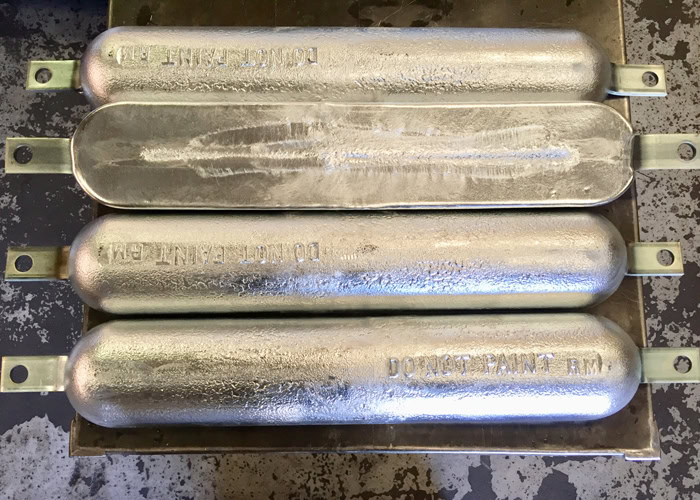 Product quality certification and installation standards are often overlooked risk points. Anodes that comply with national standards such as ASTM B418 or GB/T 4948 should have a chemical composition deviation rate of less than 2% and possess a third-party certification mark. In 2021, a certain shipping company used non-standard zinc anodes (with aluminum content exceeding the standard by 1.5%), which led to the protection potential not meeting the minimum requirement of -0.85V. As a result, the corrosion rate of the hull increased by 0.2 millimeters per year within 18 months, causing additional maintenance costs of over 500,000 yuan. The correct installation requires that the conductive contact area between the anode and the protective body be greater than 80%, the connection resistance be less than 0.001 ohms, and the distribution density be optimized through computer simulation to avoid protection blind spots, thereby enhancing the overall protection effect to over 90%.
From the perspective of market trends, the global anode market size is expected to reach approximately 5 billion US dollars in 2024, with an annual growth rate of 4.5%, but the price fluctuation range can reach ±15%. When making a purchase, it is necessary to evaluate whether the supplier has the ISO 9001 quality system certification and provides at least a 10-year performance warranty. Case analysis shows that for enterprises that follow the above procurement principles, the average mean time between failures of their equipment is extended by 40%, and the full life cycle maintenance cost is reduced by 25%. Whether it is protecting submarine pipelines worth hundreds of millions or extending the lifespan of household water heaters by 50%, a scientific procurement strategy can amplify the role of this small component tenfold. This is precisely the core wisdom of investment in corrosion prevention and control.
Product quality certification and installation standards are often overlooked risk points. Anodes that comply with national standards such as ASTM B418 or GB/T 4948 should have a chemical composition deviation rate of less than 2% and possess a third-party certification mark. In 2021, a certain shipping company used non-standard zinc anodes (with aluminum content exceeding the standard by 1.5%), which led to the protection potential not meeting the minimum requirement of -0.85V. As a result, the corrosion rate of the hull increased by 0.2 millimeters per year within 18 months, causing additional maintenance costs of over 500,000 yuan. The correct installation requires that the conductive contact area between the anode and the protective body be greater than 80%, the connection resistance be less than 0.001 ohms, and the distribution density be optimized through computer simulation to avoid protection blind spots, thereby enhancing the overall protection effect to over 90%.
From the perspective of market trends, the global anode market size is expected to reach approximately 5 billion US dollars in 2024, with an annual growth rate of 4.5%, but the price fluctuation range can reach ±15%. When making a purchase, it is necessary to evaluate whether the supplier has the ISO 9001 quality system certification and provides at least a 10-year performance warranty. Case analysis shows that for enterprises that follow the above procurement principles, the average mean time between failures of their equipment is extended by 40%, and the full life cycle maintenance cost is reduced by 25%. Whether it is protecting submarine pipelines worth hundreds of millions or extending the lifespan of household water heaters by 50%, a scientific procurement strategy can amplify the role of this small component tenfold. This is precisely the core wisdom of investment in corrosion prevention and control.
Product quality certification and installation standards are often overlooked risk points. Anodes that comply with national standards such as ASTM B418 or GB/T 4948 should have a chemical composition deviation rate of less than 2% and possess a third-party certification mark. In 2021, a certain shipping company used non-standard zinc anodes (with aluminum content exceeding the standard by 1.5%), which led to the protection potential not meeting the minimum requirement of -0.85V. As a result, the corrosion rate of the hull increased by 0.2 millimeters per year within 18 months, causing additional maintenance costs of over 500,000 yuan. The correct installation requires that the conductive contact area between the anode and the protective body be greater than 80%, the connection resistance be less than 0.001 ohms, and the distribution density be optimized through computer simulation to avoid protection blind spots, thereby enhancing the overall protection effect to over 90%.
From the perspective of market trends, the global anode market size is expected to reach approximately 5 billion US dollars in 2024, with an annual growth rate of 4.5%, but the price fluctuation range can reach ±15%. When making a purchase, it is necessary to evaluate whether the supplier has the ISO 9001 quality system certification and provides at least a 10-year performance warranty. Case analysis shows that for enterprises that follow the above procurement principles, the average mean time between failures of their equipment is extended by 40%, and the full life cycle maintenance cost is reduced by 25%. Whether it is protecting submarine pipelines worth hundreds of millions or extending the lifespan of household water heaters by 50%, a scientific procurement strategy can amplify the role of this small component tenfold. This is precisely the core wisdom of investment in corrosion prevention and control.