PPS+ or PPLNS: Choosing How Your Shares Get Paid
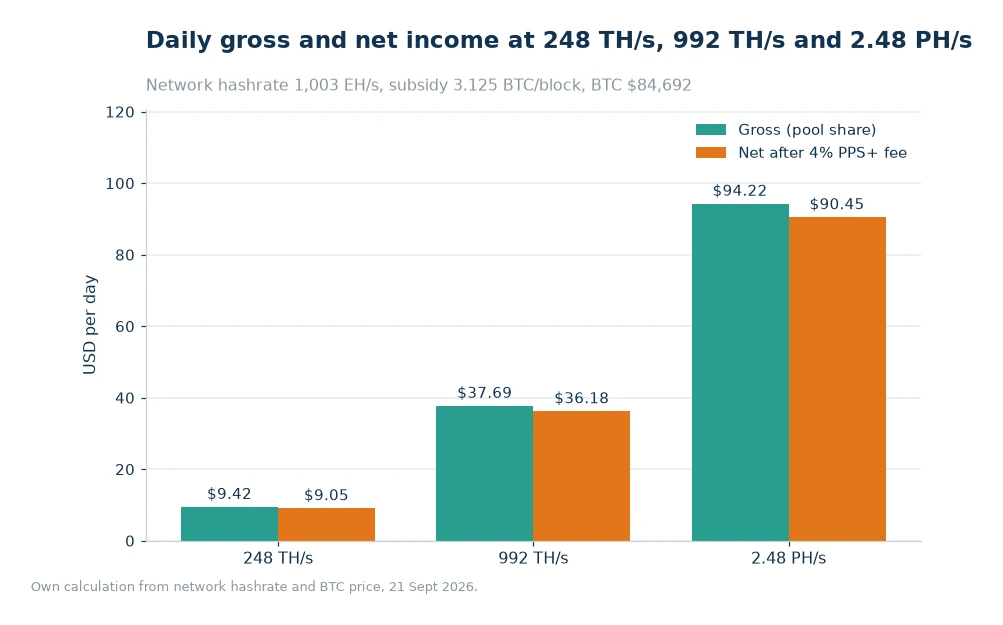
Two miners with identical hardware can earn different amounts in the same month, and the reason is often the settlement scheme rather than the machines. At 248 TH/s the gross credit is 0.00011125 BTC a day, or $9.42 at BTC $84,692: $9.05 under PPS+ with its listed 4% on the block-reward component, and about $9.23 under PPLNS with its listed 2% on the combined total.

Key takeaways
- PPS+ charges a listed 4% on the block-reward part and 2% on transaction fees, and pays hourly.
- PPLNS charges a listed 2% on both components combined but pays only after 6 confirmations.
- At 248 TH/s the difference on $9.42 gross is about 18 cents a day in favour of PPLNS.
- The higher average comes with variance: under PPLNS the miner carries pool luck that PPS+ removes.
Two different things are being sold
PPS+ sells certainty. The block-reward portion is settled per share at a fixed rate against current difficulty, so a bad streak of blocks does not reduce your credit. The pool keeps the difference between what it pays and what it finds, which is why the listed rate on that component is the higher of the two. You are buying insurance and paying a premium for it.
PPLNS sells a share of what is actually found. Your slice is measured over the last 5 difficulty rounds, and payment follows 6 confirmations on each block. Over a long enough window the average is usually better than PPS+ because the listed rate is lower, but any single day can be well above or below the model. The pool is not absorbing luck on your behalf; you are holding it.
Where the eighteen cents comes from
The difference is easy to state and easy to misplace. At ViaBTC Mining Pool, PPS+ takes 4% of the subsidy and 2% of the fee revenue; PPLNS takes 2% of the sum. On a day when transaction fees are small, the two are close, and PPLNS wins by roughly two percentage points of the subsidy. On a day when fees are large, the gap narrows, because PPS+ only charges 2% on that portion.
That is the honest version of a comparison that is often reduced to "PPLNS pays more". It usually does, slightly, and it does so in exchange for a payment stream that is lumpier and slower to arrive. Neither scheme is a mistake, and the right answer depends on what the operator needs from the cash flow.
| Item | PPS+ (default) | PPLNS |
|---|---|---|
| Listed rate, block reward | 4% | 2% on the combined total |
| Listed rate, transaction fees | 2% | 2% on the combined total |
| Net per day at 248 TH/s | $9.05 | About $9.23 |
| When it arrives | Hourly, against current difficulty | After 6 confirmations, over 5 rounds |
Read the third row as an average rather than a promise. The PPLNS figure is what the same gross income would produce at the lower listed rate, not what any particular day will pay. A week with three blocks found pays differently from a week with one, even at identical hashrate.
Variance is the price of the higher average
A small miner feels variance in a way a large one does not. At 248 TH/s, a day's credit is $9.42 gross, which is small enough that a missed block window is visible in the weekly total. At 2.48 PH/s the same percentage swing is ten times larger in dollars but arrives on a base that can absorb it, which is why large operations often prefer the scheme with the better average.
The practical test is whether a below-average week would force a decision. If it would, PPS+ is doing useful work by smoothing the stream. If it would not, the lower listed rate is free money over time, assuming the pool finds blocks at roughly its expected rate. That assumption is the whole risk, and it is worth stating plainly rather than hiding behind an average.
Matching the scheme to the bill
Electricity is billed on a schedule that does not care about block variance. A miner who pays for power monthly and receives PPLNS income in lumps can find the two rhythms disagreeing, particularly in the first weeks after switching. PPS+ hourly credits line up more naturally with a monthly utility bill because the balance grows steadily rather than in steps.
That is a cash-flow argument, not a yield argument. Over a year the difference between the schemes on the same hashrate is small, but the timing difference can matter to an operation with thin reserves. If the reserve is healthy, timing is a detail; if it is not, timing is the whole decision.
Switching without losing the thread
The scheme is a setting on the account, and changing it affects future settlements rather than past ones. Blocks already found are distributed under the rules that applied when they were found, so a switch does not retroactively move coins. What it does change is the shape of the next few statements, which is why the switch should be noted in whatever record you keep.
Do not switch in the middle of a variance experiment. Give each scheme a full difficulty period and compare the BTC totals at the same hashrate. Comparing a PPLNS month against a PPS+ month with a different hashrate or a different uptime tells you nothing, and it is the most common way miners talk themselves into a change they cannot evaluate.
Keep a note of the date of the change and the pool's own reported hashrate for that week. If the next statement looks unusually low, that note is what separates a scheme effect from a pool effect, and it saves an argument with yourself about whether the setting was worth changing.
What the default setting implies
PPS+ is the default for a reason: it produces a predictable hourly credit, which suits a miner who is still learning what normal looks like. Starting there and moving to PPLNS after a few months is a common path, because by then the operator has a baseline to compare against and can judge whether the variance is tolerable.
Starting on PPLNS and moving to PPS+ after a bad week is the opposite habit, and it usually costs money. The bad week is the scheme working as designed, not a signal about the pool. Either sequence can be right, but only one of them is a decision rather than a reaction.
Worked example
Use the chart's three hashrates to see how the scheme difference scales, then decide whether it is worth the variance.
- The daily value of a terahash is 0.00000044865 BTC, obtained by dividing 450 BTC across 1.003 billion TH/s.
- At 248 TH/s: 248 × 0.00000044865 = 0.00011125 BTC a day, or $9.42 at $84,692.
- PPS+ net: 9.42 × 0.96 = $9.05. PPLNS net: 9.42 × 0.98 = $9.23.
- 992 TH/s, four machines: $37.69 gross, $36.18 with PPS+, $36.94 with PPLNS.
- 2.48 PH/s, ten machines: $94.22 gross, $90.45 with PPS+, $92.34 with PPLNS.
- Across 30 days the gap at 248 TH/s is 30 × $0.18 = $5.40, which is real but smaller than one day of downtime.
Frequently asked questions
Is PPLNS always better than PPS+?
No. It has a lower listed rate and a better long-run average in normal conditions, but it pays after 6 confirmations and leaves the miner carrying pool luck, so any single period can be worse.
How often does PPS+ pay?
Hourly, against current difficulty, which is why a 248 TH/s account shows a steady credit rather than a lump after each block.
Does switching schemes change blocks already found?
No. Distribution follows the rules in force when the block was found, so a change applies to future settlements only.
Decide once, then measure for a month
Write both net figures at your hashrate on a single line, note the timing difference beside them, and choose the one that matches your reserve. Then leave it alone for at least one full difficulty period. The published fee schedule is the source for both listed rates, and the account view shows which scheme is active before you change anything.
If you want a second opinion on the arithmetic, the Profit Calculator takes a fee input and returns a daily estimate, which is enough to check that the scheme you picked is the one you thought you picked.
Sources: the ViaBTC pricing page and settlement documentation[1]. The 21 Sept 2026 snapshot: 1,003 EH/s network hashrate, 132.76 T difficulty, 3.125 BTC a block, 144 blocks a day, BTC $84,692. Published 24 Oct 2026; PPLNS results depend on blocks found.